
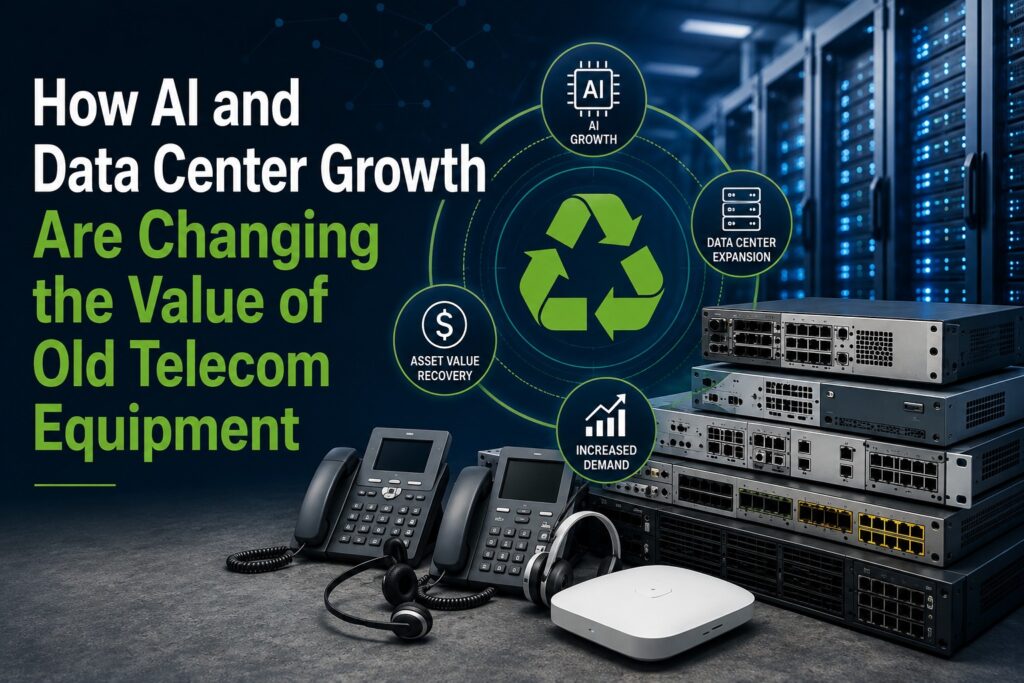
The rapid growth of artificial intelligence is transforming more than the way businesses use technology. It is also changing the infrastructure required to support that technology – and, in turn, creating new opportunities for businesses with surplus, retired, or obsolete telecom equipment.
AI applications require enormous amounts of computing power, storage, connectivity, and networking infrastructure. As organizations invest in new data centers and modernize existing networks, large volumes of older equipment are being replaced.
For businesses, this raises an important question:
Is old telecom equipment really waste, or could it still have recoverable value?
In many cases, equipment that is no longer suitable for one organization may still have value through resale, refurbishment, reuse, parts recovery, or responsible recycling.
As AI-driven infrastructure investment continues to grow, understanding the changing value of retired telecom equipment can help businesses make better financial, operational, security, and sustainability decisions.
Artificial intelligence has created a significant increase in demand for computing infrastructure. Generative AI, machine learning, large language models, analytics, and other AI workloads require substantial computing and data-processing capacity.
This is contributing to continued investment in data centers and supporting infrastructure.
While GPUs and specialized processors often receive the most attention when discussing AI infrastructure, they are only one part of the equation. AI data centers also depend on extensive networking and communications infrastructure to move data between systems quickly and reliably.
This includes equipment such as:
The result is a growing technology lifecycle challenge. New infrastructure is being deployed at the same time that older infrastructure is being upgraded, replaced, or decommissioned.
For businesses, that means more equipment entering the secondary market.
AI workloads depend heavily on high-speed connectivity.
Large-scale AI systems move enormous amounts of data between compute resources, storage systems, and other parts of the network. Data center operators therefore need networking infrastructure capable of supporting increasingly demanding workloads.
At the same time, organizations outside the data center sector are continuing to modernize their own networks.
Businesses may upgrade their:
When these upgrades happen, perfectly functional equipment may be removed simply because it no longer meets the organization’s technical, performance, security, or compatibility requirements.
That distinction is important.
Equipment can be obsolete for one organization without being worthless in the broader market.
One of the biggest misconceptions about technology disposal is that equipment becomes worthless as soon as an organization replaces it.
In reality, there are several potential paths for retired equipment.
A business may be able to:
The right option depends on the equipment’s condition, age, manufacturer, model, quantity, market demand, and technical specifications.
This creates a secondary market where equipment that no longer makes sense for one company may still provide an economical solution for another.
For organizations managing large technology refreshes, this can turn equipment retirement from a disposal expense into an asset recovery opportunity.
Instead of asking only, “How do we get rid of this equipment?” businesses should also ask:
“What value can we recover from these assets before they leave our facility?”
Not every retired device will have significant resale value. However, many categories of telecom and IT equipment can potentially retain value after they are removed from active service.
Networking hardware can include:
The value of these assets can vary significantly depending on the manufacturer, model, age, specifications, condition, and current demand.
Businesses may also have surplus:
Some organizations may continue to operate legacy systems and require replacement units, spare parts, or compatible equipment.
Technology refreshes can also generate surplus:
Even when complete systems are no longer commercially attractive, individual components may have potential value.
Equipment that cannot reasonably be reused or resold may still contain recoverable materials.
Depending on the equipment, this can include materials such as:
The value of these materials is influenced by commodity markets and the composition of the equipment.
That is why a proper asset evaluation is important before making a disposal decision.
The value of retired telecom equipment isn’t limited to the resale market.
Telecommunications infrastructure contains significant quantities of materials that can be recovered through responsible recycling.
Copper is particularly important because it has long been used throughout telecommunications infrastructure, including cabling and other network components.
As network operators and businesses transition from legacy infrastructure toward newer technologies, significant volumes of older equipment and materials can enter the recovery stream.
Changing commodity prices can also affect the economics of recycling.
This means businesses should think about equipment value at multiple levels:
Product value > component value > material value
An asset may have enough market demand to be resold as a complete product. If not, components may still be useful. If neither option is viable, responsible material recovery may be the appropriate final step.
Recycling plays an essential role in responsible electronics disposal, but it should not necessarily be the first option for every piece of retired equipment.
There is a hierarchy of potential recovery:
| Recovery option | Potential benefit |
|---|---|
| Reuse | Extends the useful life of the equipment |
| Refurbishment | Restores equipment for continued use |
| Resale | Creates potential financial recovery |
| Parts recovery | Captures value from usable components |
| Recycling | Recovers valuable raw materials |
The most appropriate option depends on the asset.
For example, a working network switch with an active secondary-market demand may have significantly more value as a resold product than as scrap.
On the other hand, equipment that is damaged, outdated, or no longer economically viable may be better suited for responsible recycling.
The key is to evaluate before disposing.
Organizations planning a network upgrade, office closure, data center migration, or technology refresh can take several steps to improve their asset recovery results.
Start by documenting what you have.
Useful information can include:
A detailed inventory makes it easier to evaluate potential resale and recovery opportunities.
Not every asset should be treated the same way.
Separate equipment into categories such as:
This helps determine whether an item is better suited for reuse, resale, refurbishment, parts recovery, or recycling.
The original purchase price doesn’t necessarily determine today’s value.
A relatively old piece of equipment may still have demand because businesses need:
Conversely, newer equipment may have little resale value if the market has moved away from that particular technology.
Network and telecom equipment can contain sensitive business information, configurations, credentials, or other data.
Before equipment is sold, reused, or recycled, businesses should have an appropriate data sanitization or destruction process.
Data security should never be sacrificed in pursuit of asset recovery.
Once equipment has been evaluated, determine the best path:
Reuse > Resale > Refurbishment > Parts Recovery > Recycling
Not every asset will follow the same path, and a professional asset recovery process can help businesses determine the most appropriate disposition strategy.
Businesses should maintain appropriate records showing what happened to retired equipment.
Depending on the organization’s requirements, documentation may include:
This provides greater visibility and accountability throughout the equipment lifecycle.
Recovering money from retired equipment is valuable, but protecting business information is more important.
Telecom and network devices may contain configuration information that could expose details about an organization’s infrastructure.
Depending on the device and how it was used, this could include information such as:
This is why secure IT asset disposition should combine asset recovery with data security.
A responsible process should establish clear chain-of-custody procedures and ensure appropriate data sanitization or destruction before equipment is resold, reused, or recycled.
For businesses, the goal should not simply be to maximize the resale price.
It should be to maximize recoverable value while maintaining security and compliance requirements.
The financial benefits of equipment recovery are only part of the story.
Technology reuse and refurbishment can also contribute to a more circular approach to electronics.
When usable equipment remains in circulation, businesses can potentially:
This becomes particularly relevant as technology refresh cycles accelerate.
The more quickly businesses replace infrastructure, the more important responsible asset disposition becomes.
A traditional technology lifecycle can look like:
Purchase > Use > Replace > Dispose
A circular approach looks more like:
Purchase > Use > Reuse > Refurbish > Resell > Recover Materials
The objective isn’t to keep every piece of equipment in service indefinitely.
Rather, it is to identify the highest-value and most responsible next step for each asset.
AI is likely to continue influencing technology infrastructure investment for years to come.
As businesses and data center operators deploy new infrastructure, equipment refresh cycles will continue to generate retired hardware.
This could create several opportunities for the secondary market.
Organizations upgrading infrastructure may retire equipment sooner than they otherwise would.
That means more hardware could enter resale and recovery channels.
Not every organization needs the newest available technology.
Businesses with budget constraints, legacy environments, testing requirements, or less demanding workloads may find value in quality used or refurbished equipment.
As demand for infrastructure materials changes, the recovery value of components and raw materials may become an increasingly important consideration when evaluating retired equipment.
The biggest change may be conceptual.
Instead of viewing retired equipment simply as waste, businesses can begin treating it as part of their asset recovery strategy.
That shift can help organizations identify opportunities to generate financial returns, support sustainability objectives, and improve the overall management of technology assets.
Before sending old telecom or IT equipment for disposal, businesses should ask:
These questions can help prevent businesses from overlooking potential value.
The growth of AI and data centers is creating demand for new infrastructure, but it is also increasing the importance of what happens to the equipment being replaced.
For businesses, this creates an opportunity to rethink the traditional approach to technology disposal.
Old telecom equipment isn’t automatically worthless.
Depending on its condition, specifications, market demand, and material composition, it may have value through reuse, refurbishment, resale, parts recovery, or recycling.
The right strategy is therefore not simply to dispose of equipment as quickly as possible.
It is to determine the most appropriate way to recover its remaining value while protecting sensitive information and supporting responsible environmental practices.
If your business has surplus, obsolete, or retired telecom and IT equipment, Telecom Recycle can help you determine the appropriate recovery path.
From equipment resale and reuse to responsible recycling and asset recovery, evaluating your equipment before disposal can help you capture potential value while supporting a more responsible technology lifecycle.
Have telecom equipment you’re ready to retire? Contact Telecom Recycle to find out what your surplus equipment may be worth.
Have questions about the value, resale, reuse, and responsible recycling of retired telecom equipment? Find answers to common questions below.
Yes. Old telecom equipment may still have value depending on its manufacturer, model, age, condition, specifications, quantity, and current market demand. Depending on the asset, it may be reused, refurbished, resold, used for parts recovery, or recycled for its recoverable materials.
Businesses may be able to recover value from networking equipment such as switches, routers, wireless access points, firewalls, and connectivity hardware, as well as business phones, VoIP phones, PBX systems, servers, storage equipment, rack equipment, and other IT infrastructure. Equipment that cannot be resold may still have value through parts or material recovery.
Businesses should evaluate their equipment before sending it directly for recycling. Functional equipment with current secondary-market demand may generate greater value through reuse, refurbishment, or resale, while damaged, obsolete, or economically unviable equipment may be better suited for parts recovery or responsible recycling.
Equipment value depends on factors such as the manufacturer, model, age, quantity, condition, technical specifications, and current market demand. Creating an inventory with model numbers, serial numbers, quantities, condition, and accessories can help determine the most appropriate recovery option and potential value.
Businesses should use an appropriate data sanitization or destruction process before retired telecom or network equipment leaves their facility. Devices can contain network configurations, credentials, IP information, user information, and other sensitive data, so asset recovery should include secure data handling, appropriate chain-of-custody procedures, and documentation of data destruction or sanitization.
We wants to buy your used IT assets. Get a free quote today!
Get My Free Quote
The rapid growth of artificial intelligence is transforming more than the way businesses use technology. It is also changing the…
Read More
Modernizing your office telecom environment often means replacing legacy PBX or older VoIP systems with cloud communications, SIP-based platforms, or…
Read More
When we discard an old phone, few of us consider it as worthless trash. But behind the cracked screens and…
Read More
Got a pile of old Mitel phones collecting dust in your office? You’re not alone. Many businesses upgrade their communication…
Read MoreWe wants to buy your used IT assets. Get a free quote today!
Get Free Quote


© 2025 TelecomRecycle. All Rights Reserved.